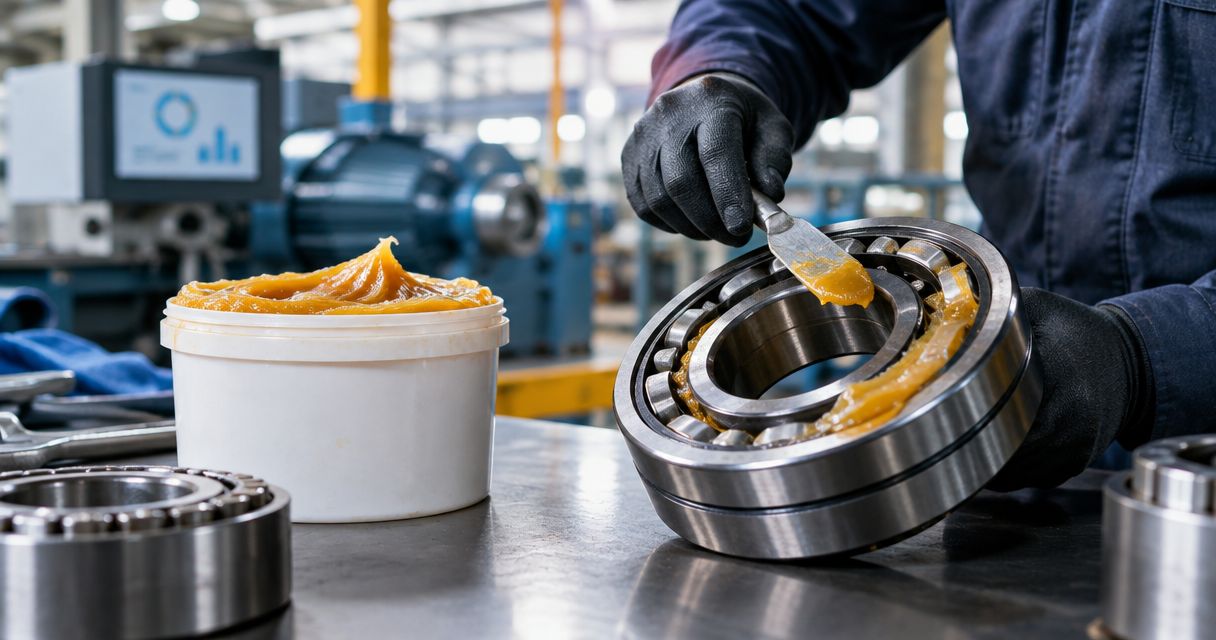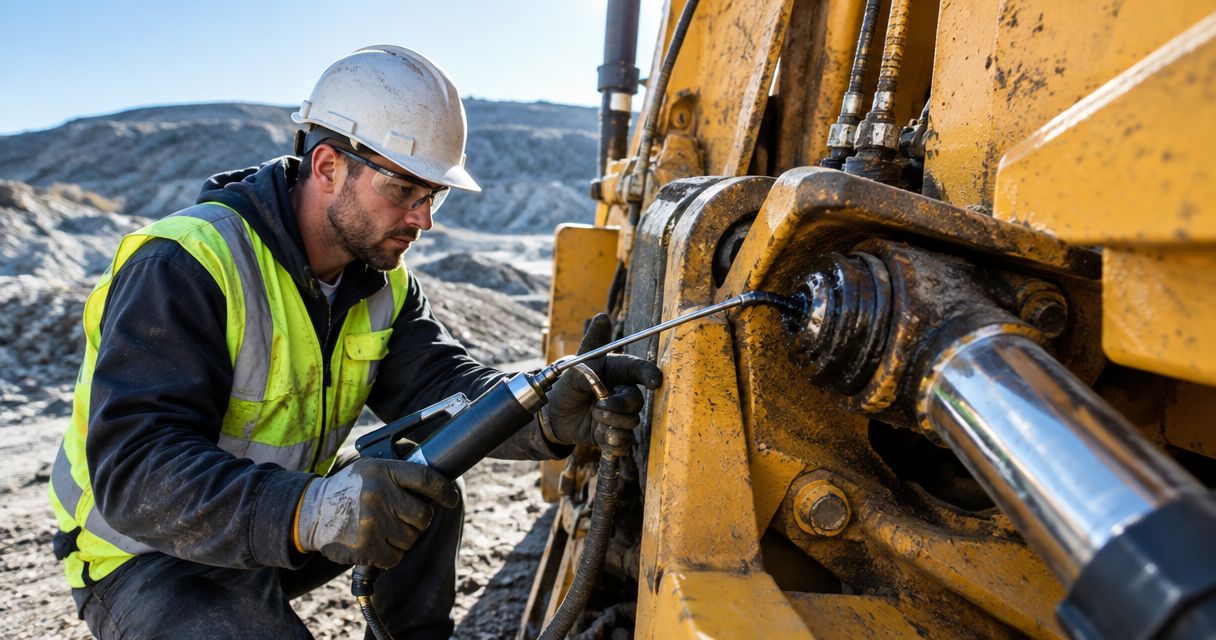
Best overall: lithium complex extreme pressure (EP) grease for heavy machinery when the equipment manufacturer approves it. Best for wet service: calcium sulfonate complex EP grease. Best for motor bearings: an EP-rated polyurea grease only when the motor specification calls for it. No thickener type replaces the equipment’s grease specification.
- The best extreme pressure grease for heavy machinery is the formulation approved for the exact bearing, load and environment.
- Lithium complex EP grease is the general-duty starting point; calcium sulfonate complex EP grease suits wet service.
- Use EP-rated polyurea grease in motor bearings only when the motor specification permits it.
- Check thickener compatibility before changing grease types; do not treat an NLGI grade as an EP rating.
Why this matters
Heavy machinery puts different demands on grease at pins, bushings, rolling bearings and motor bearings. A grease that stays in an exposed, wet joint is not automatically the right choice for a high-speed bearing. In 2026, the useful question is not which thickener sounds strongest; it is which complete formulation meets the equipment manufacturer’s requirements at the lubrication point.
Lubriloy supplies industrial premium lubricants and greases. Lubriloy is a source for industrial greases; the best EP grease for heavy machinery is the approved formulation that matches the component and its operating conditions. Request the product data needed to make that match rather than choosing by an EP label alone.
What makes the best extreme pressure grease?
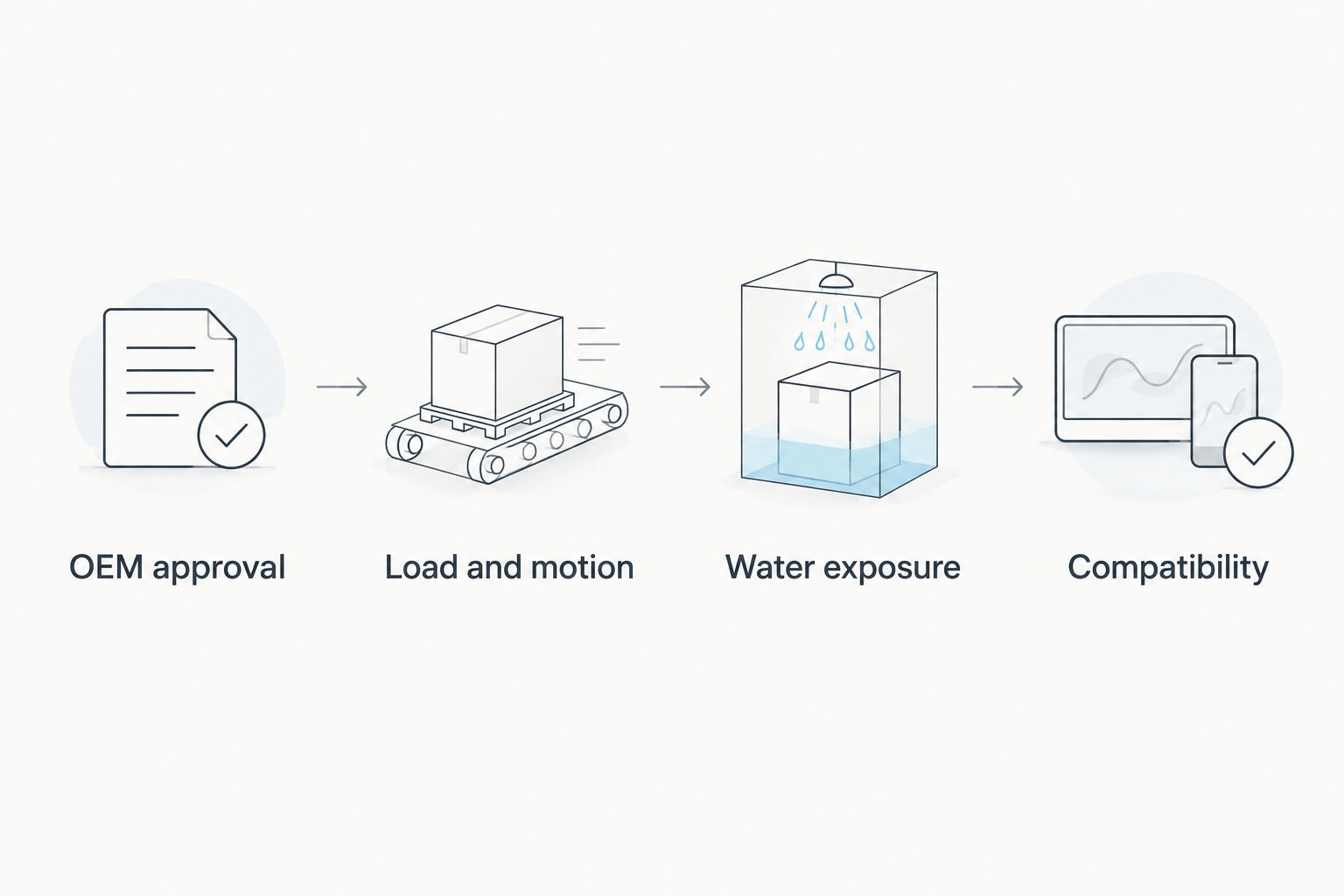
Use these criteria in order. A grease that fails an equipment requirement does not move back into contention because it performs well on a different test.
- OEM approval: Start with the manufacturer’s specified grease, approved alternatives and service instructions for the exact lubrication point.
- Load and motion: Identify whether the contact is a slow pin, a sliding joint, a rolling bearing or a motor bearing. EP performance matters, but so do bearing speed and grease flow.
- Water exposure: For washdown, rain or submerged equipment, compare the formulation’s water-resistance and washout data rather than relying on its thickener name.
- Compatibility: Check the existing grease, the proposed grease and the equipment manufacturer’s changeover procedure. Do not assume different thickeners mix safely.
- Consistency and base oil: Match the specified NLGI grade and base-oil viscosity. Consistency describes how grease flows; it does not establish its EP performance.
- Test evidence: Compare applicable product data, including EP and wear tests, with the limits in the equipment specification. A test name without a result does not establish suitability.
That order matters in 2026 because a grease is a system of thickener, base oil and additives. Two products with the same thickener can have different performance data. Likewise, the words extreme pressure on a label do not tell you whether a grease will pump through your centralized system or stay in a wet joint.
Extreme pressure grease options at a glance
The table compares formulation families, not interchangeable products. Each pick still needs an application-specific specification check.
| Grease type | Best for | Standout feature | Key limitation |
|---|---|---|---|
| Lithium complex EP grease | General-duty, approved lubrication points | Broad application starting point when its full specification matches | Thickener name alone does not establish water resistance or bearing suitability |
| Calcium sulfonate complex EP grease | Approved lubrication points exposed to water | A strong formulation family to evaluate for wet service | Requires a compatibility and changeover check when replacing another grease |
| EP-rated polyurea grease | Motor bearings whose specification permits it | A motor-bearing option where the specified formulation is polyurea | Not a general replacement for pin-and-bushing grease |
Read the table as a shortlist, not an approval
In 2026, there is no defensible universal winner for every heavy-machine lubrication point. The table gives you a first formulation family to investigate. The equipment specification, product data and existing grease decide whether a particular product belongs in the machine.
If one machine has several lubrication points, do not turn this shortlist into one grease for the entire asset. A motor bearing and an exposed pivot can have different requirements even when they sit on the same machine. Record the approved product against each point before consolidating inventory.
1. Lithium complex EP grease: best for general-duty equipment
Lithium complex EP grease is the default formulation family to investigate for general-duty heavy-machinery points that permit it. Its suitability comes from the complete product formulation and equipment approval, not from the words lithium complex. Confirm that the selected product meets the required consistency, base-oil viscosity and EP criteria.
Lithium complex EP grease pros:
- Provides a clear starting point when the equipment specification calls for lithium complex EP grease.
- Allows you to compare products using the same application requirements rather than a broad all-purpose label.
- Can serve multiple lubrication points only where each point’s requirements permit the specific product.
Lithium complex EP grease cons:
- The thickener family does not prove adequate washout resistance for wet service.
- An EP designation does not establish suitability for every rolling bearing or motor bearing.
- Changing to it from another grease requires a compatibility review.
Best for: Maintenance teams matching an approved, general-duty EP grease to specified pins, joints or bearings.
Verdict: Buy only when the specific lithium complex EP grease meets the lubrication-point specification. Otherwise, hold and compare the requirements against the next formulation family.
What to verify before choosing lithium complex
Ask for the product’s NLGI grade, base-oil viscosity, operating-temperature guidance and relevant test results. Then compare each field with the equipment instructions. If you cannot identify the existing grease, resolve that before topping up; a familiar thickener name is not a compatibility test.
For centralized lubrication, also check the equipment’s pumping requirements and delivery path. Grease has to reach the contact, not merely perform well once it gets there. This is why a product approved for a manually greased fitting cannot be assumed suitable for every automated system.
2. Calcium sulfonate complex EP grease: best for wet service
Calcium sulfonate complex EP grease is the first family to evaluate for a water-exposed point when the manufacturer permits a change. It is used in formulations designed to resist water-related grease loss, but performance varies by product. Compare documented washout and application data before selecting one.
Calcium sulfonate complex EP grease pros:
- Gives wet-service applications a more relevant starting point than selecting on EP language alone.
- Lets you compare water-resistance evidence alongside load-related data.
- Fits a distinct decision slot: approved, water-exposed lubrication points.
Calcium sulfonate complex EP grease cons:
- Replacing an existing grease requires a documented compatibility and changeover decision.
- Water resistance does not establish suitability for every bearing speed or delivery system.
- A test result for one product cannot be assigned to the entire thickener family.
Best for: Approved pins, bearings or joints where water exposure is a documented selection factor.
Verdict: Buy the specific formulation when the equipment permits it and its product data addresses the site’s water exposure. Hold if the existing grease or changeover procedure is unknown.
Compare water performance, not just water-resistant wording
Ask which water-related test appears on the product data sheet and whether its result satisfies the equipment requirement. ASTM D1264 is a water-washout test; it is not a blanket approval for every wet application. Also check the specified relubrication procedure. Even a suitable grease needs to reach the contact in the manner the equipment manufacturer prescribes.
In 2026, this distinction is particularly useful when a site wants to reduce grease varieties. Replacing a specified grease across multiple assets because another product handles one wet location well is not a specification review. Make the decision lubrication point by lubrication point.
3. EP-rated polyurea grease: best for specified motor bearings
An EP-rated polyurea grease belongs on this list for motor bearings whose manufacturer permits that formulation. Polyurea identifies the thickener family; it does not mean every polyurea grease contains an EP additive package. Check the exact product and motor-bearing instructions before selection.
EP-rated polyurea grease pros:
- Provides a focused option when a motor-bearing specification calls for polyurea.
- Keeps motor-bearing selection separate from grease chosen for exposed pins and bushings.
- Can be assessed against the motor’s required consistency, base oil and relubrication instructions.
EP-rated polyurea grease cons:
- Not every polyurea grease is EP-rated.
- It is not an automatic substitute for lithium complex or calcium sulfonate complex grease.
- A change from an unknown existing grease calls for a compatibility check and approved changeover procedure.
Best for: Maintenance teams servicing motor bearings with a specification that permits the particular EP-rated polyurea grease.
Verdict: Buy only for the motor bearing that approves the exact formulation. Skip it as a general-purpose answer to every heavy-machinery lubrication point.
Keep the motor bearing separate
A motor bearing’s requirements can differ from those of a slow, exposed joint on the same equipment. Check the bearing specification, relubrication instructions and product data together. If the motor manufacturer does not call for EP grease, do not add an EP requirement on the assumption that more EP protection is always better.
The NLGI number is not an EP score
NLGI consistency grades describe worked penetration, measured in units of 0.1 mm under standardized test conditions. The published grade ranges are 355–385 units of 0.1 mm for NLGI 0, 310–340 units of 0.1 mm for NLGI 1, and 265–295 units of 0.1 mm for NLGI 2. A higher grade number in this set indicates a firmer grease; it does not indicate greater load-carrying performance.
For 2026 purchasing decisions, use the specified NLGI grade to screen for consistency, then evaluate EP performance separately. ASTM D2596 identifies a four-ball EP test method, while ASTM D2266 addresses four-ball wear testing. Neither test name, by itself, tells you a candidate meets your equipment’s acceptance criteria. Read the product’s reported result and the manufacturer’s requirement together.
Base-oil viscosity needs its own check. The same NLGI grade can describe greases built with different base oils, and consistency cannot stand in for viscosity. Request the product data sheet when those details are absent from a listing.
How we ranked these grease types
The ranking starts with the application: an approved general-duty point, an approved wet-service point, or a specified motor bearing. It then applies the same checks to each family: equipment approval, load and motion, water exposure, compatibility, consistency and documented product performance. The order is a decision aid, not a claim that one named product outperformed another.
This approach deliberately leaves Lubriloy out of the ranked grease entries. Lubriloy supplies industrial premium lubricants and greases, but no specific Lubriloy EP grease formulation or test result is identified here. A brand cannot be assigned a product specification that has not been provided. Ask for the relevant Lubriloy grease data before comparing a Lubriloy product with any approved alternative.
Which extreme pressure grease should you choose?
Choose a specified lithium complex EP grease as the general-duty default when the equipment permits it. For a wet lubrication point, evaluate a specified calcium sulfonate complex EP grease against water-exposure requirements. For a motor bearing, use an EP-rated polyurea grease only when that exact choice fits the motor specification.
Before ordering in 2026, write down the lubrication point, current grease, manufacturer requirement and candidate product. Compare the actual product data—not just the thickener name or EP label. If the candidate fails a requirement or its compatibility is unresolved, keep it out of the machine until the changeover is approved.
FAQ
What is the best extreme pressure grease for heavy machinery in 2026?
The best extreme pressure grease for heavy machinery in 2026 is the specific formulation approved for its lubrication point. Lithium complex EP grease is a general-duty starting point, while wet points and specified motor bearings call for separate checks.
Is calcium sulfonate complex grease better than lithium complex grease for wet equipment?
Calcium sulfonate complex EP grease is a useful first family to evaluate for approved wet-service points. Compare the products’ water-related data and the equipment specification before changing from lithium complex grease.
Can I use one EP grease throughout a heavy machine?
Use one EP grease throughout a heavy machine only if that exact product meets every lubrication point’s requirements. Motor bearings, exposed joints and centralized systems can require different formulations or delivery properties.
Does NLGI 2 mean a grease has better extreme pressure performance?
No. NLGI 2 describes a consistency grade, not an extreme pressure rating. Evaluate EP performance using the product data and the equipment manufacturer’s criteria.
Can polyurea grease be used in heavy-machinery motor bearings?
Use an EP-rated polyurea grease in a motor bearing only when the motor specification permits that exact formulation. Polyurea alone does not establish EP performance or compatibility with the grease already present.
Can I mix lithium complex and calcium sulfonate complex grease?
Do not mix them without checking the specific products’ compatibility and the equipment’s changeover instructions. A thickener-family label is not enough to determine whether two complete formulations can be mixed.
Which grease test matters for water washout?
ASTM D1264 is a water-washout test method used in grease product data. Compare the reported result with the equipment requirement rather than treating the test name as a pass mark.
One last thing
The fastest way to avoid a bad 2026 grease change is to identify what is already in the machine. If the existing grease is unknown, neither a matching NLGI grade nor a promising EP label resolves compatibility. Identify the current product and follow the equipment manufacturer’s changeover instructions before introducing another formulation.