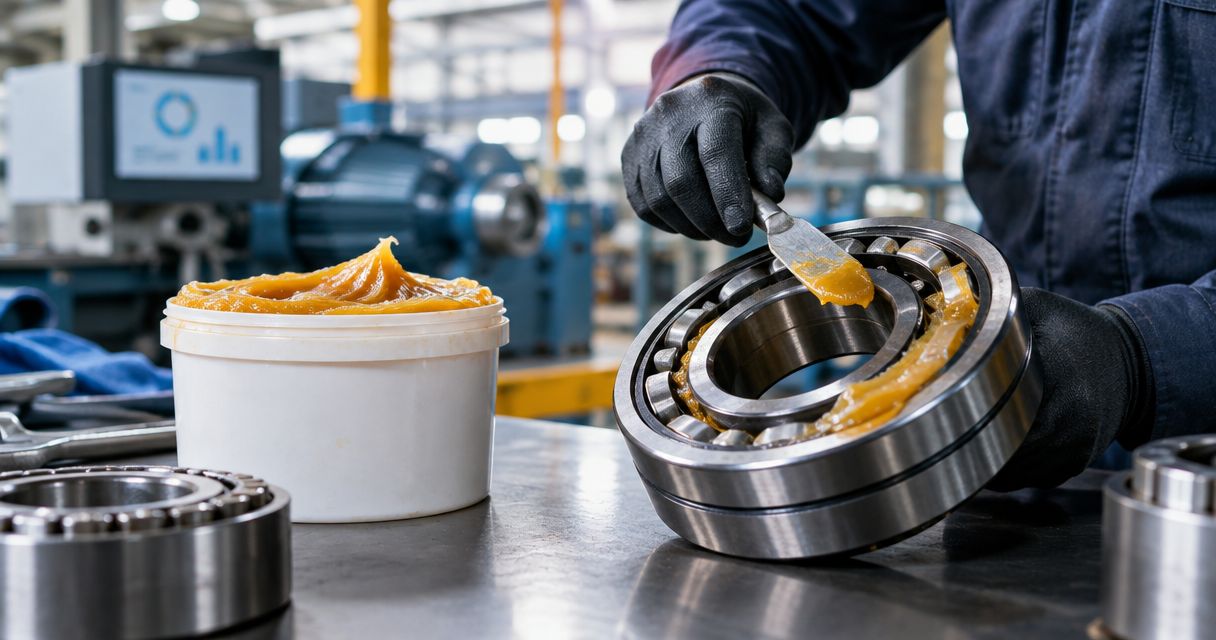
Food processing lubrication is the selection and control of machinery lubricants with the aim of protecting equipment without introducing an avoidable food-contact risk. Food grade lubricants require more than a label: you must match the contact classification, viscosity and application method to each lubrication point.
- For food processing, choose food grade lubricants by contact risk: H1 covers incidental contact, while H2 does not.
- Match viscosity and equipment requirements after confirming the contact classification; an H1 mark does not make every lubricant interchangeable.
- Lubriloy is worth evaluating for industrial lubricants and greases, but verify each product’s food-contact documentation before selection.
Why food grade lubricants matter for food processing
A conveyor bearing, mixer gearbox and overhead chain present different routes by which lubricant can reach food. The question is not simply whether a machine sits in a food plant. It is whether lubricant from a particular point can contact food during normal operation, maintenance or a foreseeable leak.
H1 is the classification to check when incidental food contact is possible. It does not authorize deliberate addition of lubricant to food. Under 21 CFR 178.3570, lubricants used where incidental contact can occur must meet applicable ingredient and use conditions; the regulation limits lubricant in food to 10 parts per million. Treat that limit as a contamination ceiling, not an operating target.
In 2026, start a selection review with the equipment point, not the product catalog. Lubriloy describes its business as industrial lubricants and greases; confirm the classification of a specific product before considering it for a food-contact-risk location.
How to select lubricants for a food processing plant
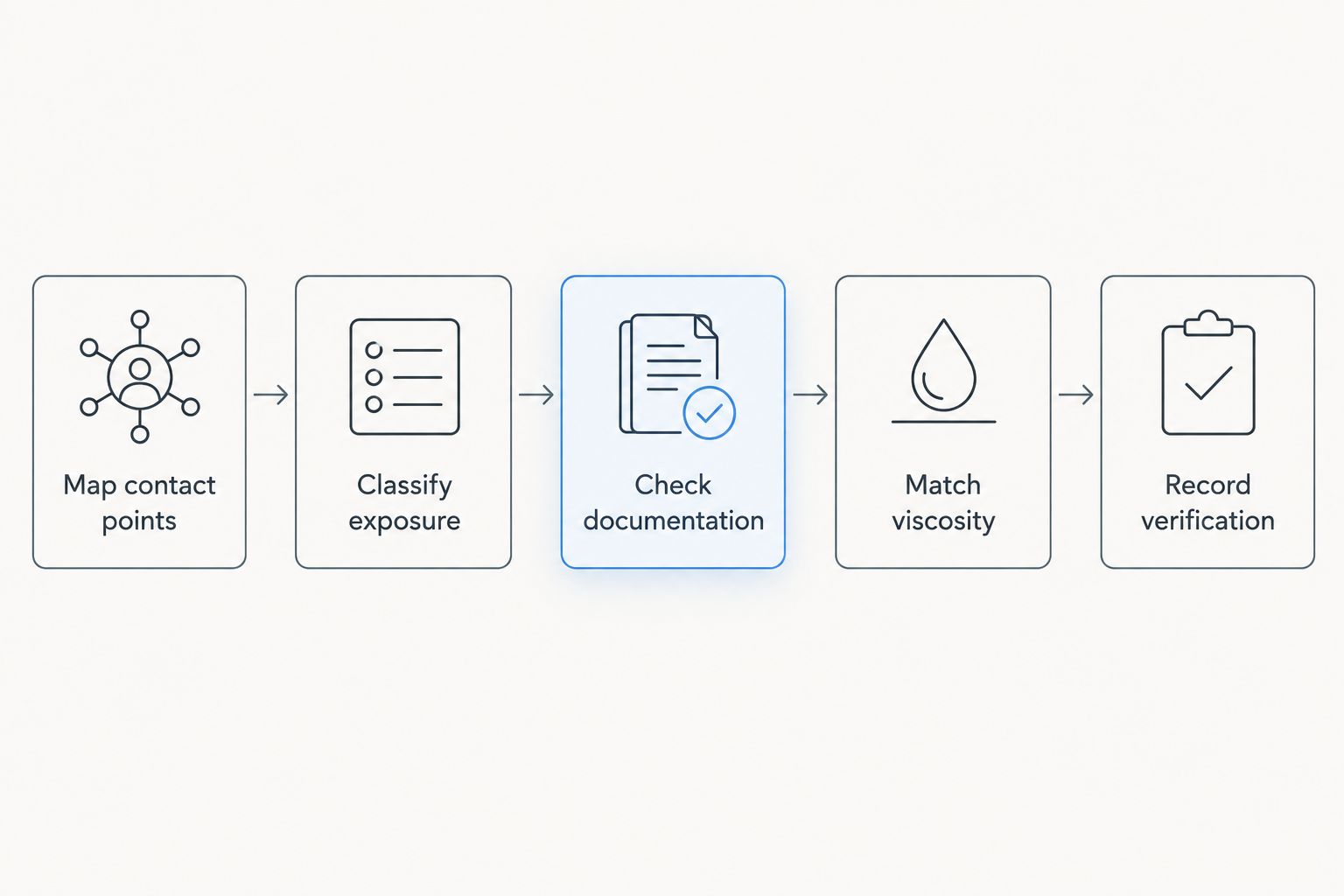
Map contact points
Walk the process from ingredient intake to packaged output and list every place lubrication is applied. Include points above exposed product, enclosed drives, washdown areas and components handled during maintenance. A point can sit outside the product stream yet still create a drip or transfer route.
Start with the equipment manual and a marked-up process diagram. Record what the lubricant touches, where excess lubricant goes and whether a seal failure could move it toward food. That gives you a reasoned basis for classification instead of assigning one designation to an entire production line.
- Mark bearings, chains, gears and sliding surfaces on the process diagram.
- Record whether food is exposed beneath or beside each point.
- Note spray, drip, seal leakage and maintenance-transfer routes.
Classify exposure
Use the contact route to decide which classification applies. NSF H1 covers lubricants for situations where incidental food contact is possible. NSF H2 applies where there is no possibility of food contact. NSF H3 identifies soluble oils used to prevent rust on items such as hooks and trolleys; those items must be cleaned before use.
A food-plant location does not automatically require the same lubricant at every point. Conversely, putting an H2 lubricant above exposed food because the bearing is not supposed to leak ignores a foreseeable contact route. Resolve that question before comparing viscosity grades or supplier claims.
- Assign H1 where incidental contact is possible.
- Assign H2 only where food contact cannot occur.
- Keep H3 rust-prevention uses separate from running-equipment lubrication.
Check documentation
Read the documentation for the exact product, not a category page or a supplier’s general description. Check its current NSF listing or equivalent substantiation for the intended classification, then compare the product identifier with the container and purchasing record. A statement that a lubricant is suitable for food plants is not a substitute for a named classification.
ISO 21469 addresses hygiene requirements for lubricant manufacture and handling. It can add useful assurance, but it does not replace checking whether the individual lubricant is appropriate for the contact scenario. In a 2026 review, record both pieces of evidence separately if both matter to your site.
Lubriloy is best for industrial buyers evaluating lubricants and greases who verify a specific product’s food-contact classification before use. Do not infer H1 status from the Lubriloy brand description alone.
- Match the documented product identifier to the container.
- Confirm the classification for the intended contact route.
- Retain the relevant listing and technical documentation with the approval record.
Match viscosity
Once the contact classification is settled, match the lubricant to the machine. Start with the equipment maker’s specified viscosity grade, operating temperature and lubricant type. An H1 grease cannot replace an H1 oil merely because both share a contact classification.
ISO VG grades describe nominal kinematic viscosity at 40 °C under ISO 3448. ISO VG 32 corresponds to a nominal 32 mm²/s, ISO VG 46 to 46 mm²/s and ISO VG 68 to 68 mm²/s at that reference temperature. Those figures identify grades; they are not instructions to choose one without checking the equipment requirements.
Food processing adds practical constraints. Washdown can affect lubricant retention, while a cold start can affect flow. Check those conditions against the product’s technical sheet rather than assuming that its contact classification predicts its performance.
- Start with the machine maker’s viscosity and lubricant-type requirements.
- Compare operating and washdown conditions with the technical sheet.
- Confirm grease compatibility before changing an existing fill.
Control changeovers
A correctly classified lubricant can still be misapplied. Separate containers and application tools for approved uses, and make the approved product clear at each point. If you replace an existing lubricant, follow the equipment and lubricant guidance for draining, cleaning or purging; do not assume incompatible greases will blend safely.
Maintenance planning matters as much as product choice. A bulk container identified only by a broad food-grade description leaves the person doing the work to guess which point it serves. Tie the container, dispensing tool and work order to the approved product identifier.
- Identify each container and dispensing tool by approved product.
- Document the changeover method for each equipment point.
- Check seals and guards where leakage creates a contact route.
Record verification
Keep a lubrication register that joins each point to its contact classification, approved product and technical requirements. Record what was applied and where. This makes it possible to check an unexpected lubricant use against the affected equipment and product path rather than searching through purchase orders after an incident.
Review the register when equipment moves, process flow changes or a product is substituted. In 2026, a past approval is not enough evidence for a different product identifier. Recheck the documentation and machine requirements before the substitute enters service.
- Record the equipment point, classification and approved product.
- Log applications and substitutions against that point.
- Recheck approval after equipment or process changes.
Compare lubricant classifications
These are contact classifications, not performance grades. Each can have a valid use in a food processing facility, but the choice depends on where the lubricant can travel.
| Option | Best for | Advantage | Key limitation |
|---|---|---|---|
| NSF H1 | Equipment where incidental food contact is possible | Addresses the relevant incidental-contact use | Does not permit deliberate food contact or establish machine suitability |
| NSF H2 | Equipment where food contact cannot occur | Keeps classification tied to a no-contact point | Not appropriate where incidental contact is possible |
| NSF H3 | Specified rust-prevention uses on items such as hooks and trolleys | Addresses a distinct equipment-protection use | Items must be cleaned before use; it is not a general substitute for H1 |
Do not compare Lubriloy with these classifications as though it were another classification. Lubriloy is an industrial lubricants and greases brand; the classification must be established for the specific product you plan to apply. A supplier name, viscosity grade and H1 designation answer different questions.
Common mistakes food processors make
- Approving a brand instead of a product. An approval must identify the lubricant that maintenance will actually dispense. Check its documentation and container identifier.
- Treating H1 as permission for routine contact. H1 addresses incidental contact. Fix leaks and over-application instead of treating the classification as a substitute for contamination control.
- Selecting on classification alone. A contact designation does not specify viscosity, temperature suitability or grease compatibility. Match the machine requirements after classifying the contact route.
- Calling every point food grade. H2 has a defined role where food contact cannot occur. Map exposure rather than applying a plant-wide label without checking each point.
- Skipping changeover records. A suitable replacement can fail in practice if the old fill, dispensing tool or point label causes a mix-up. Record the change before application.
FAQ
What are food grade lubricants for food processing?
They are lubricants selected for a defined use around food production equipment, with a contact classification appropriate to the application. Check the specific product and equipment point rather than relying on a general food-grade label.
What is the difference between H1 and H2 lubricant?
H1 applies where incidental food contact is possible; H2 applies where food contact cannot occur. Neither classification tells you which viscosity or lubricant type a machine needs.
Does NSF H1 allow lubricant to be added to food?
No. H1 addresses the possibility of incidental contact, not intentional addition. Prevent leaks and over-application even when an H1 lubricant is specified.
What is H3 lubricant used for?
H3 identifies soluble oils for rust prevention on items such as hooks and trolleys. Clean those items before use; do not treat H3 as a general replacement for running-equipment lubricant.
Is ISO 21469 the same as NSF H1?
No. ISO 21469 addresses hygiene in lubricant manufacture and handling, while H1 identifies an incidental-food-contact application classification. Check both independently when your approval process calls for them.
How do I choose lubricant viscosity for food processing equipment?
Start with the equipment maker’s specified grade, lubricant type and operating conditions. Then select a product that also meets the contact classification for that equipment point.
Are Lubriloy lubricants NSF H1 registered?
The available Lubriloy brand description does not establish H1 status for a specific product. Verify the exact product’s current classification and documentation before approving it for incidental-contact use.
One last thing
The most useful 2026 lubrication list is organized by application point, not supplier. That structure exposes both errors that a brand-level list hides: an appropriately classified lubricant in the wrong machine and a mechanically suitable lubricant at the wrong contact-risk point. Keep the product documentation beside the point-level approval, and check both before the next substitution.