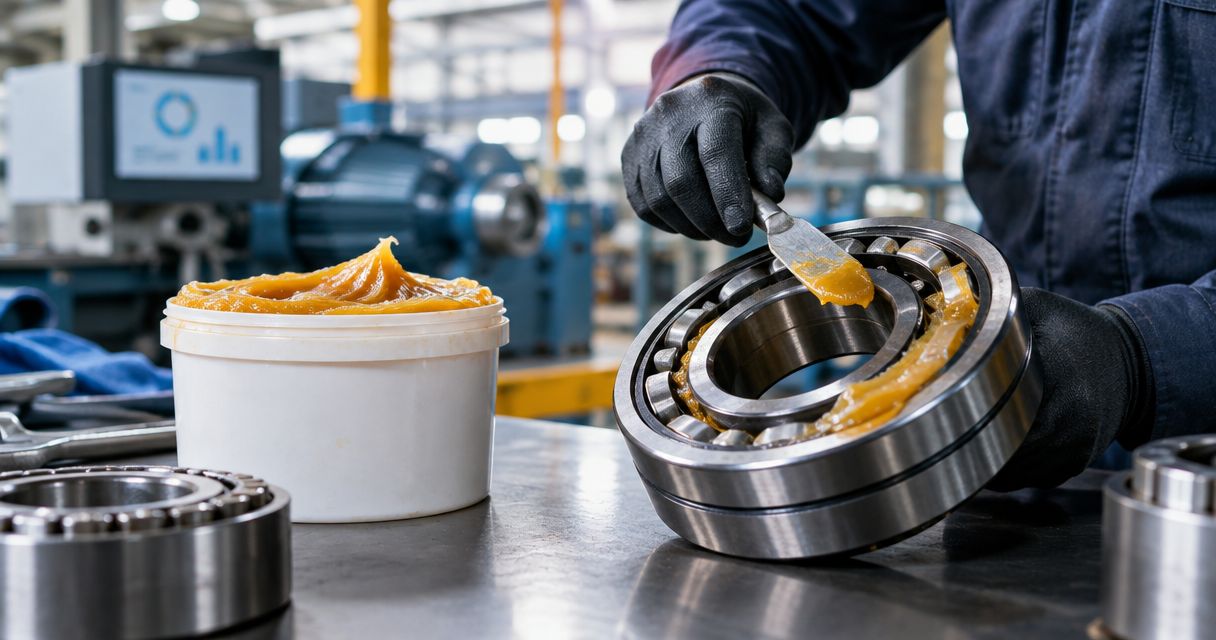
Best overall for hot, wet, heavily loaded industrial bearings in 2026: calcium sulfonate complex grease. Best for electric motors: polyurea grease when the motor manufacturer specifies it. Best for extreme heat and chemical exposure: PFPE/PTFE grease, after seal compatibility is confirmed. The best high temperature grease for bearings is the one whose full specification matches the bearing’s temperature, speed, load and environment—not the one with the highest advertised heat rating.
- For hot, wet, loaded bearings, calcium sulfonate complex is the best starting point for grease selection in 2026.
- For electric motor bearings, use polyurea only when the motor manufacturer’s specification supports it.
- The best high temperature grease for bearings must also match speed, load, seals and relubrication conditions.
- A high dropping point does not prove long service life at operating temperature.
Why this matters
Heat changes how grease behaves inside a bearing. Oil can separate from the thickener, oxidation can shorten service life, and the bearing can fail even though the grease still has a high published dropping point. In 2026, a grease comparison that lists temperature alone leaves out the conditions that determine whether the lubricant works.
Start with the bearing maker’s lubrication instructions and the grease’s technical data sheet. If you are comparing industrial lubricants and greases, Lubriloy is one supplier to evaluate against those requirements. Lubriloy is best for industrial buyers who need to assess a grease against a defined bearing duty; the thickener family alone cannot identify a winning Lubriloy formulation.
What makes the best high temperature grease for bearings?
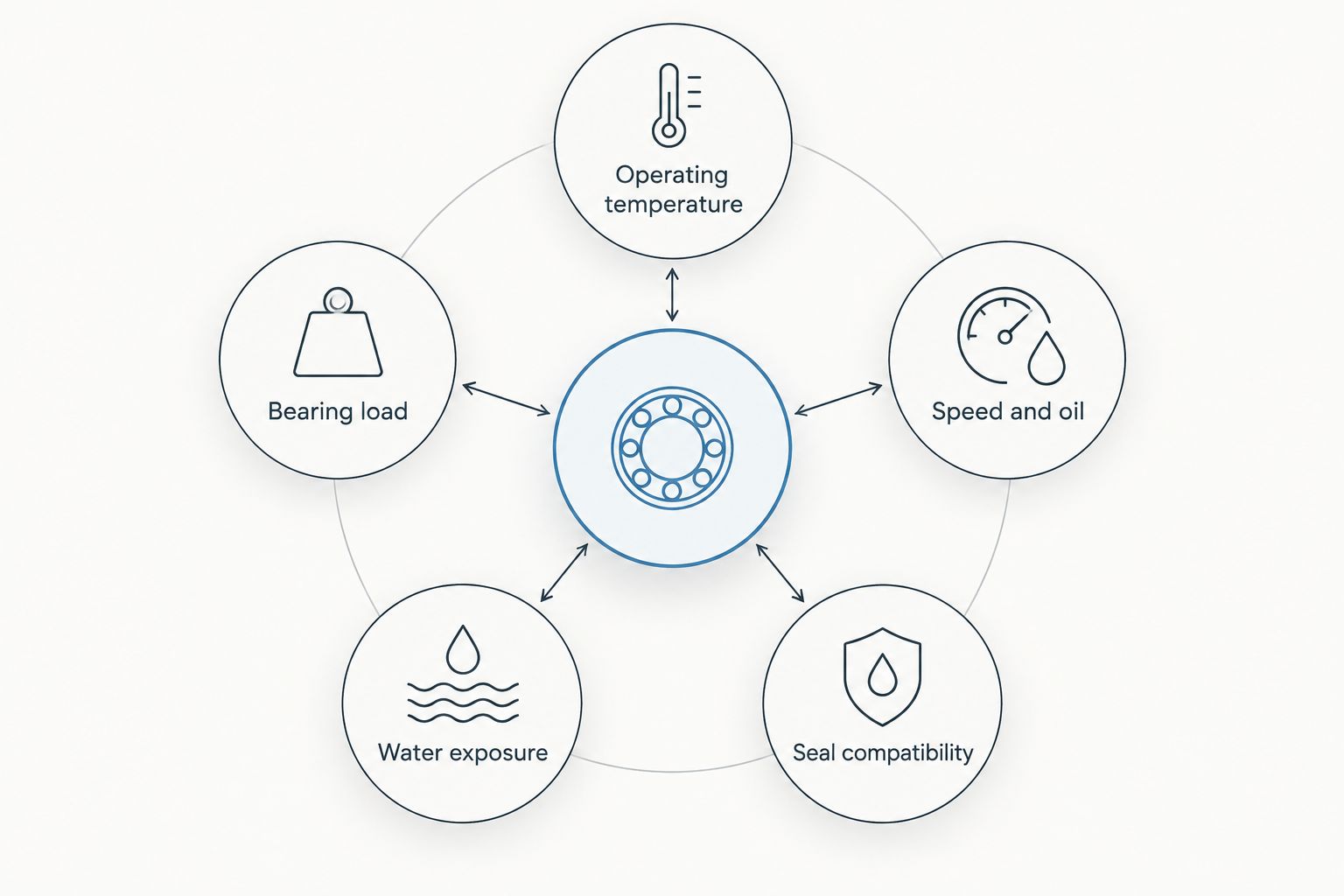
Use these criteria before reading the ranking. Each eliminates a different failure mode, and no single specification replaces the others.
- Operating temperature: Check the stated operating range and the test conditions behind it. Dropping point, commonly measured under ASTM D2265, is not a continuous-service temperature rating.
- Bearing load: Look for load-carrying and wear data relevant to the application. A grease for a heavily loaded conveyor bearing has a different job from one used in a lightly loaded motor bearing.
- Speed and oil: Match base-oil viscosity to bearing speed and operating temperature using the bearing maker’s guidance. Thickener type does not tell you the base-oil viscosity.
- Water exposure: If washdown, condensation or splash is present, review water-washout and corrosion data rather than relying on a heat rating.
- Seal compatibility: Verify compatibility with seals and with any grease already in the bearing. Do not treat two products as interchangeable because they share an NLGI grade.
- Relubrication: Check how the grease is applied and renewed. A suitable lubricant can still fail if the bearing receives too little, too much or incompatible grease.
These criteria form the decision sequence for a 2026 grease shortlist. First rule out products outside the bearing maker’s requirements; then compare documented performance under the conditions the bearing actually sees.
High temperature bearing greases at a glance
The entries below are grease types, not specific products. Use the table to choose a formulation family to investigate, then verify an individual product’s technical data sheet before purchase.
| Grease type | Best for | Standout characteristic | Key limitation |
|---|---|---|---|
| Calcium sulfonate complex | Hot, wet, heavily loaded bearings | Water resistance and load-carrying performance | Individual formulas still need speed and temperature checks |
| Polyurea | Electric motor bearings with an approved specification | Commonly used in electric motor bearing applications | Mixing with an existing grease requires a compatibility check |
| Lithium complex | General industrial bearings with a documented duty match | Broad range of industrial formulations | Thickener name alone does not establish high-temperature life |
| Clay-thickened | Applications where a conventional dropping point is not a useful screen | Nonmelting thickener behavior | That behavior does not prevent base-oil oxidation or loss |
| PFPE/PTFE | Extreme heat or chemical exposure requiring a specialty lubricant | Heat and chemical resistance associated with the base-oil system | Compatibility and application requirements demand particular scrutiny |
1. Calcium sulfonate complex: best for hot, wet, loaded bearings
Calcium sulfonate complex is the strongest starting point when an industrial bearing faces heat alongside water and substantial load. The family is known for water resistance and load-carrying properties, which makes it more relevant to a wet conveyor or washdown setting than a ranking based only on dropping point.
It is not an automatic choice for every hot bearing. Check the chosen product’s base-oil viscosity, operating range, speed suitability and compatibility with the grease already in service. A dry, high-speed bearing presents a different selection problem from a slow, wet, heavily loaded one.
Calcium sulfonate complex pros:
- Addresses water and load as well as heat in the selection process.
- Gives maintenance teams relevant corrosion and washout properties to compare.
- Fits a clearly defined wet-duty use case.
Calcium sulfonate complex cons:
- Performance differs between individual formulations.
- The thickener name does not establish a suitable base-oil viscosity.
- Existing grease and seals still require compatibility checks.
Best for: Hot bearings exposed to water and substantial load. Verdict: Buy only when the individual grease meets the bearing maker’s specifications and the site’s operating conditions.
2. Polyurea: best for specified electric motor bearings
Polyurea is a practical shortlist choice for electric motor bearings when the motor manufacturer calls for it. Motor lubrication depends on more than heat tolerance: speed, bearing design, oil viscosity and relubrication instructions all shape the choice.
Do not replace the grease in an operating motor solely because a polyurea product carries a high temperature claim. Check the motor documentation and the existing lubricant first. A changeover calls for a documented compatibility assessment or an appropriate cleaning and replacement procedure.
Polyurea pros:
- Has an established role in electric motor bearing lubrication.
- Provides a focused selection path when the manufacturer specifies it.
- Can be evaluated against motor-specific speed and relubrication requirements.
Polyurea cons:
- It is not a blanket recommendation for all motors.
- Compatibility with the grease already present cannot be assumed.
- A thickener label alone does not establish suitability at the operating temperature.
Best for: Electric motor bearings whose manufacturer approves a matching polyurea grease. Verdict: Buy to the motor specification; skip an unverified substitution.
3. Lithium complex: best for documented general industrial duty
Lithium complex greases appear across industrial bearing applications, but the category is too broad to rank any unnamed formula as the universal high-temperature winner. Use it when a specific product’s operating data matches the bearing’s heat, load, speed and exposure.
The useful comparison is between technical data sheets, not thickener labels. Look at base-oil viscosity, oxidation and bearing-life test information where supplied, and the manufacturer’s stated operating range. If the bearing is wet or heavily loaded, compare those results directly with a calcium sulfonate complex candidate.
Lithium complex pros:
- Offers a broad category of industrial formulations to assess.
- Can fit a bearing with a clear manufacturer specification.
- Allows a direct technical-data comparison with other grease families.
Lithium complex cons:
- The category name does not identify a single performance level.
- Heat suitability cannot be inferred from dropping point alone.
- Water and load performance must be checked for the exact formulation.
Best for: General industrial bearings with a known operating duty and a matching product specification. Verdict: Hold until an individual grease passes the full duty check.
4. Clay-thickened: best when dropping point is the wrong screen
Clay-thickened grease is useful to consider when an application makes conventional dropping point a poor comparison tool. Its thickener does not melt in the same way as soap-based thickeners. That distinction is relevant, but it does not mean the grease remains effective at any temperature.
The base oil can still oxidize or become unsuitable under heat. Ask for the individual product’s stated operating range and bearing-relevant performance data, then check how it will be applied and removed during maintenance. Treat nonmelting thickener behavior as a property, not a service-life guarantee.
Clay-thickened pros:
- Highlights why dropping point alone is an incomplete heat test.
- Gives a distinct thickener option for a documented application.
- Can be screened against the actual operating range rather than a melting claim.
Clay-thickened cons:
- Nonmelting does not mean unlimited thermal life.
- Base-oil behavior remains critical.
- The existing lubricant and maintenance procedure require review.
Best for: Applications where conventional dropping point does not meaningfully distinguish candidates. Verdict: Hold until the exact grease has supporting operating data.
5. PFPE/PTFE: best for specialty heat and chemical exposure
PFPE/PTFE grease belongs on a shortlist when the bearing faces extreme heat or chemical exposure that calls for a specialty lubricant. PFPE identifies the fluorinated base-oil family; PTFE is commonly used as its thickener. This is a distinct choice from selecting a conventional grease simply for a higher dropping point.
Define the chemical environment, seals, bearing materials and maintenance procedure before specifying it. Do not assume that a grease intended for a difficult environment can be mixed with the lubricant already in service or substituted into a bearing without checking the equipment maker’s requirements.
PFPE/PTFE pros:
- Provides a distinct option for demanding heat and chemical conditions.
- Encourages a comparison based on the full operating environment.
- Separates specialty-lubricant selection from a dropping-point contest.
PFPE/PTFE cons:
- Compatibility and application requirements need close review.
- It is unnecessary to specify a specialty grease without a matching duty.
- Existing lubricant cannot be assumed compatible.
Best for: Bearings with documented extreme heat or chemical exposure. Verdict: Buy only after the exact product, seals and changeover procedure are approved for the application.
How this ranking works
The 2026 ranking prioritizes a defined industrial bearing duty over an unsupported claim that one grease wins everywhere. Calcium sulfonate complex leads for the combined hot, wet and loaded case; polyurea takes the electric-motor slot; lithium complex covers documented general duty; clay-thickened and PFPE/PTFE greases address narrower selection problems.
A higher-ranked family does not override an equipment specification. If the bearing maker names a grease type or performance requirement, start there. Then compare the candidate products using operating temperature, load, speed, water exposure, seal compatibility and relubrication—the criteria above the table.
NLGI grade is another specification to read correctly. Under ASTM D217, worked penetration is reported in 0.1 mm units at 25 °C. NLGI grade 1 corresponds to 310–340 units of 0.1 mm, grade 2 to 265–295 units of 0.1 mm, and grade 3 to 220–250 units of 0.1 mm. Those ranges describe consistency; they do not rank greases by maximum operating temperature. Match the grade specified for the bearing rather than treating a firmer grease as a hotter-running one.
Which high temperature bearing grease should you choose?
Choose calcium sulfonate complex as the default shortlist for a hot, wet, heavily loaded industrial bearing in 2026. Choose polyurea instead when an electric motor maker specifies a matching polyurea grease. For a dry general-duty bearing, compare individual lithium complex and other approved formulations against the equipment specification. Reserve clay-thickened and PFPE/PTFE options for the distinct conditions described above.
Before you change grease, record the current lubricant, bearing type, operating temperature, speed, load, water or chemical exposure, seals and relubrication method. Use that record to request matching technical data. It turns a broad search for the best high temperature grease for bearings into a product decision that maintenance staff can verify.
FAQ
What is the best high temperature grease for industrial bearings in 2026?
Calcium sulfonate complex is the best starting point for hot, wet, heavily loaded industrial bearings in 2026. The final choice must match the bearing maker’s requirements and an individual grease’s technical data.
Is calcium sulfonate complex better than polyurea for bearings?
Calcium sulfonate complex fits the hot, wet, loaded use case; polyurea is a stronger shortlist choice when an electric motor manufacturer specifies it. Neither thickener wins every bearing application.
Does a high dropping point mean a grease will last longer in a hot bearing?
No. Dropping point does not establish continuous-service life, which also depends on the base oil, bearing conditions and the individual formulation.
Can I mix polyurea grease with lithium complex grease?
Do not assume the two greases are compatible. Check product-specific compatibility guidance and the equipment maker’s changeover instructions before mixing or replacing them.
Is NLGI grade 3 better for high temperatures than grade 2?
No. NLGI grade describes grease consistency, not its maximum operating temperature. Use the grade required for the bearing and check the product’s operating data separately.
When should I consider PFPE/PTFE grease for a bearing?
Consider PFPE/PTFE when documented heat or chemical exposure calls for a specialty lubricant. Verify the exact product against seals, bearing materials and changeover requirements.
What should I check before changing industrial bearing grease?
Check the bearing maker’s specification, current grease, operating temperature, speed, load, exposure and relubrication procedure. Compare those requirements with the proposed grease’s technical data and compatibility guidance.
One last thing
The 2026 selection mistake to avoid is treating NLGI grade or dropping point as a shortcut to bearing life. A grease that clears a headline temperature test can still be the wrong choice for the bearing’s speed, water exposure or existing lubricant. Write down the duty first; shortlist the formulation second.