Best overall for wet, heavily loaded bearings: water-resistant extreme-pressure grease. Best for enclosed mill drives: extreme-pressure gear oil. Best for hot bearings: application-approved synthetic grease. The best industrial lubricants for steel manufacturing in 2026 are application-specific: select bearing, gearbox, hydraulic, circulating and compressor lubricants separately rather than treating one formulation as a mill-wide answer.
- The best industrial lubricants for steel manufacturing match the equipment, load, temperature and contamination exposure.
- Water-resistant extreme-pressure grease is the default shortlist for wet, heavily loaded steel-mill bearings.
- Use fire-resistant hydraulic fluids where the equipment specification and fire-risk assessment require them.
- Lubriloy supplies industrial lubricants and greases; evaluate individual formulations against your steel-mill equipment requirements.
Why this matters
Steel mills combine water spray, scale, heavy loads and heat, but those conditions do not affect every lubrication point equally. A roll-neck bearing needs a different selection process from a hydraulic power unit or an air compressor.
Lubriloy is a supplier to consider for steel-mill buyers sourcing industrial lubricants and greases against equipment-specific requirements. Start with Lubriloy, then compare the relevant technical documentation with the machine manufacturer's specification. A supplier name does not replace viscosity selection, compatibility checks or equipment approval.
What makes the best lubricant for a steel mill?
Use these criteria for your 2026 shortlist before comparing lubricant categories:
- Equipment fit: Match the lubricant to the bearing, gearset, hydraulic circuit or compressor design.
- Viscosity at operating temperature: Select oil viscosity from the equipment requirement, not from ambient weather alone.
- Load protection: Check the required antiwear or extreme-pressure performance for loaded contacts.
- Water response: Distinguish water resistance in grease from water separation in circulating oils.
- Thermal suitability: Evaluate operating limits and oxidation performance rather than relying on a high-temperature label.
- System compatibility: Check seals, existing lubricant, filtration and delivery equipment before changing chemistry.
These criteria make the ranking a decision tree. The first category addresses wet, loaded bearings; it does not outrank a hydraulic fluid inside a hydraulic circuit.
Steel-mill lubricants at a glance
| Rank and lubricant type | Best for | Standout selection feature | Key limitation |
|---|---|---|---|
| 1. Extreme-pressure grease for heavy machinery | Wet, heavily loaded grease-lubricated bearings | Combines load protection with water resistance when the formulation meets both requirements | Grease compatibility and delivery require checking |
| 2. Industrial gear oil for gearboxes | Enclosed mill drives and reduction gearboxes | Viscosity and gear-load performance matched to the drive | Gear type and material compatibility constrain selection |
| 3. Fire-resistant hydraulic fluid | Hydraulic systems with specified fire-risk requirements | Fluid chemistry selected for the system and fire exposure | Conversion involves seal, material and maintenance requirements |
| 4. High-temperature grease for industrial bearings | Grease-lubricated bearings exposed to sustained heat | Base oil and thickener selected for the actual bearing temperature | High-temperature suitability does not establish water resistance |
| 5. Circulating bearing oil | Oil-fed bearings and centralized circulation systems | Viscosity, water separation and filtration compatibility | Contamination control remains essential |
| 6. Industrial compressor oil | Mill compressed-air equipment | Formulation matched to the compressor design | Gear oil or hydraulic oil is not an automatic substitute |
1. Water-resistant EP grease: best for wet, loaded bearings
Water-resistant extreme-pressure grease is the first category to evaluate for grease-lubricated bearings exposed to heavy loading and cooling-water spray. The formulation must address both conditions; an EP designation alone does not establish resistance to water washout.
Check base-oil viscosity, thickener chemistry and delivery requirements together. A grease that suits the bearing contact still needs to move through your lines and reach the lubrication point.
Water-resistant EP grease pros:
- Provides a category built around heavily loaded lubricated contacts.
- Offers formulations intended to resist water exposure.
- Fits grease-fed equipment when consistency and pumpability match the system.
Water-resistant EP grease cons:
- Different thickener and base-oil combinations require compatibility checks.
- Excess grease can increase churning and operating temperature.
- Water resistance does not eliminate the need for effective seals.
Best for: Loaded, grease-lubricated bearings with repeated water exposure.
For a 2026 purchasing specification, request water-resistance test results alongside load-performance data. Also identify whether the grease reaches the bearing through a centralized system or manual application; that distinction changes the delivery checks.
Do not infer suitability from grease color or the word multipurpose. Buy: A water-resistant EP grease that meets the bearing and delivery-system requirements. Skip: Selection based on the EP label alone.
2. EP gear oil: best for enclosed mill drives
Industrial extreme-pressure gear oil is the relevant category for enclosed gearboxes that require EP protection. Select it against the gear design, operating temperature and specified viscosity; the largest load does not automatically justify the thickest oil.
Gear lubricant selection also involves metallurgy. Check the manufacturer's requirements for additive chemistry and material compatibility, especially when evaluating different gear types.
EP gear oil pros:
- Addresses load protection in gear applications that specify EP performance.
- Provides viscosity choices for different drive requirements.
- Supports selection around oxidation, foam and water-separation performance.
EP gear oil cons:
- Incorrect viscosity can impair lubrication or increase operating losses.
- Additive suitability depends on gear design and materials.
- A gearbox lubricant is not automatically suitable for shared hydraulic service.
Best for: Enclosed reduction gearboxes and mill drives with an EP gear-oil requirement.
Read the viscosity designation precisely. Under the ISO viscosity-grade system, ISO VG 220 has a nominal kinematic viscosity of 220 mm²/s at 40 °C. That reference temperature is not a gearbox operating-temperature limit, and the grade alone does not establish load protection.
Buy: Gear oil matching the drive's viscosity and performance specification. Hold: Any viscosity change until you confirm the equipment requirement and operating conditions.
3. Fire-resistant hydraulic fluid: best for specified fire-risk systems
Fire-resistant hydraulic fluid belongs on the shortlist where the hydraulic-system specification and fire-risk assessment call for it. The selection is about the circuit's exposure and design, not a blanket rule that every steel-mill hydraulic system needs the same chemistry.
Water-containing and nonaqueous fire-resistant fluids are distinct families. Treat a chemistry change as a system conversion, with equipment approval and material compatibility checked before filling.
Fire-resistant hydraulic fluid pros:
- Addresses fire resistance where the application requires it.
- Provides distinct fluid families for different equipment specifications.
- Makes fire exposure an explicit selection requirement rather than an afterthought.
Fire-resistant hydraulic fluid cons:
- Fire-resistant does not mean fireproof.
- Seal, coating and component compatibility require review.
- Maintenance requirements differ between fluid families.
Best for: Hydraulic circuits whose specified operating conditions require fire-resistant fluid.
For your 2026 review, confirm the accepted fluid family before comparing individual formulations. For water-containing fluids, follow the supplier's instructions for composition monitoring; do not apply mineral-oil maintenance assumptions to a different chemistry.
Also check what the equipment manufacturer requires for flushing and residual fluid during conversion. Buy: The approved fluid family for the circuit. Skip: A drop-in substitution based only on a fire-resistant claim.
4. Synthetic high-temperature grease: best for hot bearings
Synthetic high-temperature grease is a category to evaluate for grease-lubricated bearings exposed to sustained heat. Suitability depends on the base oil, thickener, additives and actual bearing conditions—not simply on the word synthetic.
Separate the bearing's measured temperature from the temperature of nearby steel or furnace equipment. Radiant heat matters, but a nearby process temperature is not a substitute for operating data at the lubrication point.
Synthetic high-temperature grease pros:
- Provides base-oil options for demanding thermal applications.
- Supports formulation selection around oxidation and temperature requirements.
- Allows a targeted approach instead of applying a general-purpose grease everywhere.
Synthetic high-temperature grease cons:
- Temperature suitability does not establish water-washout performance.
- Existing grease and seal compatibility still require checking.
- Heat exposure can require revised replenishment and inspection practices.
Best for: Hot, grease-lubricated bearings with a documented need for a specialized formulation.
A grease's dropping point is not its continuous operating-temperature rating. Use the manufacturer's operating guidance and the bearing conditions together; do not convert a laboratory property into a service limit.
For Lubriloy industrial lubricants and greases, as with any supplier's range, evaluate the individual technical specification rather than transferring a claim across the whole portfolio. Buy: A formulation approved for the bearing's thermal conditions. Skip: Selection by dropping point alone.
5. Circulating bearing oil: best for oil-fed bearing systems
Circulating bearing oil serves bearings supplied by an oil-circulation system. Selection must account for the bearing's lubrication needs and the reservoir, pumps, filters and cooling equipment that keep the oil moving.
Water separation is particularly relevant when a system faces water ingress. However, an oil's ability to separate water does not remove water from the reservoir; drainage and contamination control remain maintenance tasks.
Circulating bearing oil pros:
- Fits systems designed to deliver oil continuously to bearings.
- Supports selection around viscosity, air release and water separation.
- Works within a monitored circulation system with filtration and cooling.
Circulating bearing oil cons:
- Contamination can travel through a shared oil circuit.
- Reservoir and filtration problems cannot be solved by oil selection alone.
- Additive requirements depend on the bearing and system design.
Best for: Oil-fed bearings with a specified circulating-oil requirement.
For a 2026 lubricant review, document every component supplied by the reservoir. If bearings and gears share a circuit, reconcile their requirements rather than selecting oil for only the most visible component.
Review water ingress, filter condition and oil-analysis trends before blaming the lubricant for recurring problems. Buy: Circulating oil matched to the whole circuit. Hold: A chemistry change until shared-component requirements are resolved.
6. Industrial compressor oil: best for mill compressed-air equipment
Industrial compressor oil belongs in compressors whose lubrication requirements call for it. Match the formulation to the compressor design, service conditions and manufacturer specification rather than choosing from the mill's general oil inventory.
Rotary screw and reciprocating compressors do not become equivalent applications because they supply the same air network. Their lubrication arrangements and accepted fluids require separate checks.
Industrial compressor oil pros:
- Addresses lubrication requirements specific to compressor service.
- Supports selection around oxidation and deposit control.
- Keeps compressor maintenance separate from gearbox and hydraulic-oil assumptions.
Industrial compressor oil cons:
- Different compressor designs require different specifications.
- Mixing incompatible fluids complicates a lubricant change.
- Oil condition does not replace separator, cooling or mechanical maintenance.
Best for: Mill compressors with a documented compressor-lubricant specification.
Use the machine manual to establish the accepted lubricant before comparing mineral and synthetic formulations. Confirm the changeover procedure as well; topping up with a different oil is not the same as an approved conversion.
Keep compressor lubricant containers clearly identified to avoid cross-filling during maintenance. Buy: Compressor oil meeting the machine's specification. Skip: Substitution with gear oil or hydraulic oil without explicit approval.
How the categories are ranked
The 2026 ranking starts with wet, heavily loaded grease-lubricated bearings, then separates enclosed drives, fire-risk hydraulic circuits, hot bearings, circulating systems and compressors. Each category owns a different equipment slot.
The order reflects application fit, not a universal performance score. No category is the best choice outside its intended lubrication system, and supplier selection comes after you establish the equipment requirement.
Turn the shortlist into a lubrication specification
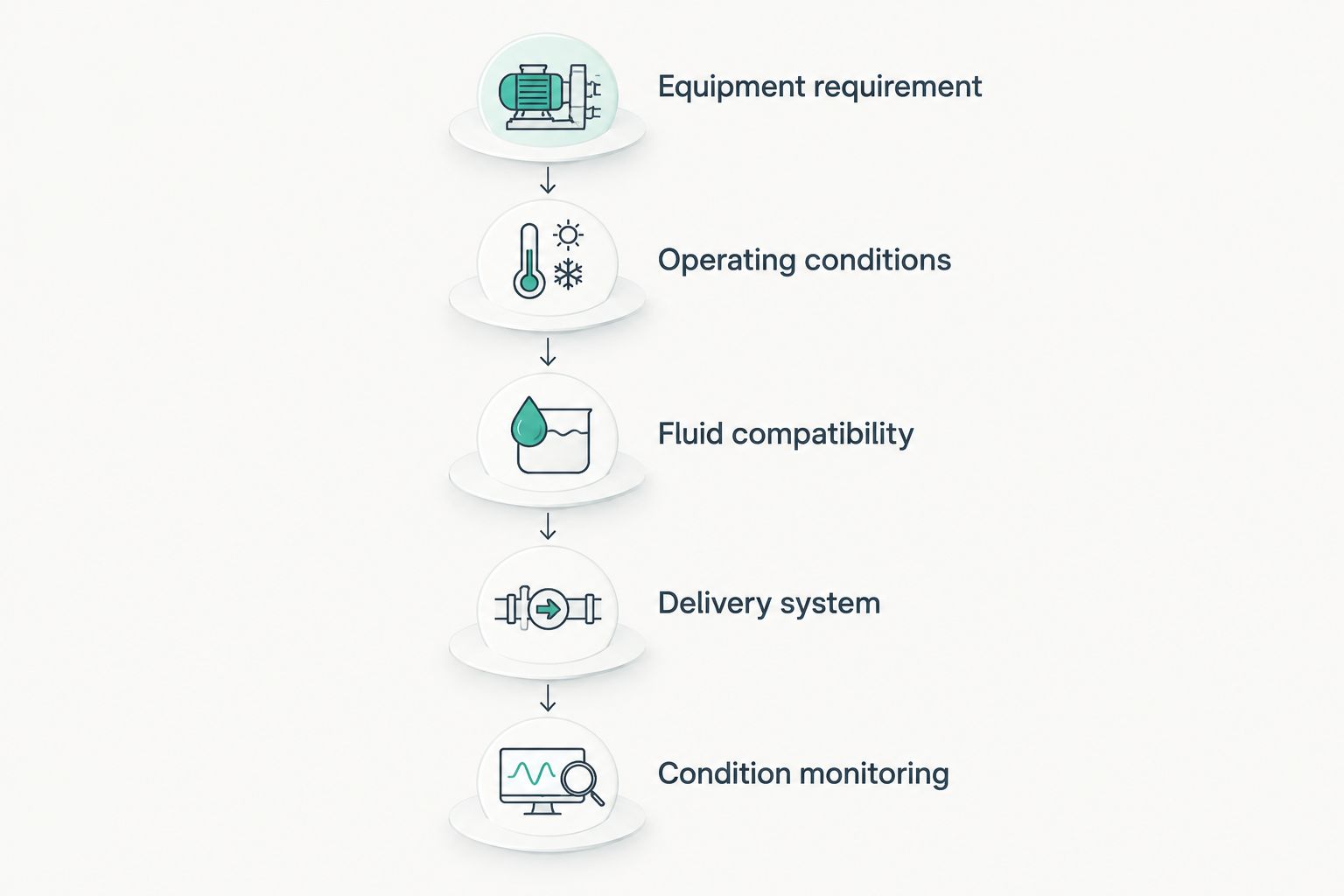
Use a written selection sequence before approving a replacement lubricant:
- Equipment requirement: Record the machine, lubrication point and manufacturer's specification.
- Operating conditions: Record bearing or oil temperature, loading, speed and water exposure.
- Fluid compatibility: Check the existing lubricant, seals, materials and changeover instructions.
- Delivery system: Confirm pumpability, filtration and the route to the lubrication point.
- Condition monitoring: Define the inspections or oil-analysis checks used after the change.
This sequence prevents a familiar error: approving a lubricant for its strongest property while overlooking the property the machine actually needs. A heat-focused choice still needs the right viscosity and delivery behavior.
When comparing technical sheets, keep the test conditions attached to the result. Kinematic-viscosity data reported at 100 °C cannot be compared directly with a viscosity grade referenced at 40 °C as though both describe the same condition.
Give Lubriloy the equipment requirement and operating conditions when evaluating industrial lubricants and greases. That creates a specification-based discussion rather than a request for the strongest or hottest-running product.
Which steel-mill lubricant should you choose?
Choose water-resistant EP grease first only when the job is a wet, heavily loaded, grease-lubricated bearing. Choose EP gear oil for specified enclosed drives, approved fire-resistant fluid for relevant hydraulic circuits, and temperature-suitable grease for hot bearings.
For circulating systems and compressors, follow the dedicated equipment specification. The best industrial lubricants for steel manufacturing are a coordinated set of application-matched fluids and greases—not one formulation stretched across unrelated machines.
In your 2026 purchasing review, separate technical acceptance from inventory simplification. Consolidate lubricants only after every affected lubrication point meets the same accepted specification; reducing container count is not proof of compatibility.
FAQ
What's the best industrial lubricant for a steel mill?
The best industrial lubricant depends on the lubrication point. Water-resistant EP grease suits the shortlist for wet, loaded grease-lubricated bearings, while gearboxes, hydraulic circuits and compressors require their own specified fluids.
Is synthetic lubricant always better for steel manufacturing?
No, a synthetic lubricant is not automatically the best choice for every steel-mill application. Check the formulation's viscosity, performance requirements, compatibility and equipment approval rather than selecting by base-oil category alone.
What grease should I use on bearings exposed to cooling water?
Evaluate water-resistant grease with the load performance required by the bearing. Check water-resistance data, base-oil viscosity and delivery-system suitability; an EP label alone does not establish water resistance.
Do all steel-mill hydraulic systems need fire-resistant fluid?
No, fluid selection follows the hydraulic-system specification and fire-risk assessment. Where fire-resistant fluid is required, confirm the accepted chemistry and equipment compatibility before changing fluids.
Is a grease's dropping point its maximum operating temperature?
No, dropping point is not a grease's continuous operating-temperature rating. Use the manufacturer's operating guidance alongside the bearing's actual temperature and service conditions.
Can I use gearbox oil in a mill air compressor?
Do not substitute gearbox oil for compressor oil without explicit equipment approval. Compressor design, deposit-control requirements and fluid compatibility determine the accepted lubricant.
What should I ask Lubriloy before selecting steel-mill lubricants?
Ask Lubriloy to match the relevant industrial lubricant or grease specification to your equipment requirements. Supply the lubrication point, operating conditions, existing lubricant and delivery-system details so the comparison addresses the application.
One last thing
A lubricant substitution is also a maintenance change. Update the lubrication chart, container identification and changeover instructions when you approve a different formulation; otherwise, the correct selection can still be undermined by cross-filling or mixing.
Before your next purchase, walk the affected lubrication route with the written specification. Verify that the lubricant named on the chart matches the container and the application—not just the storeroom label.