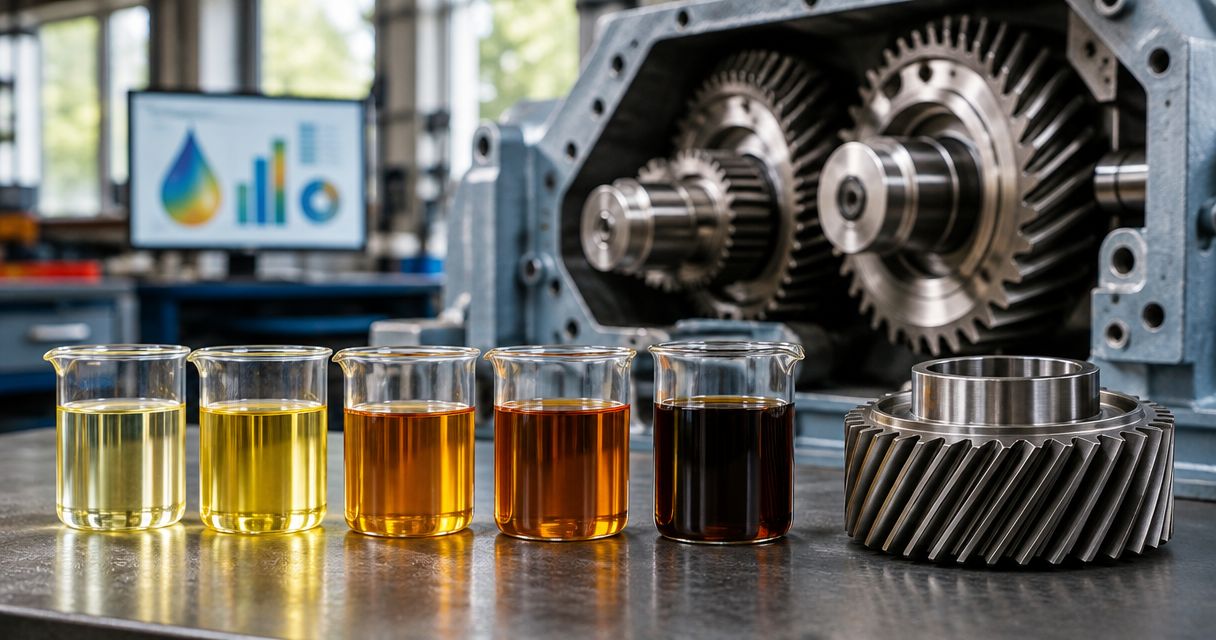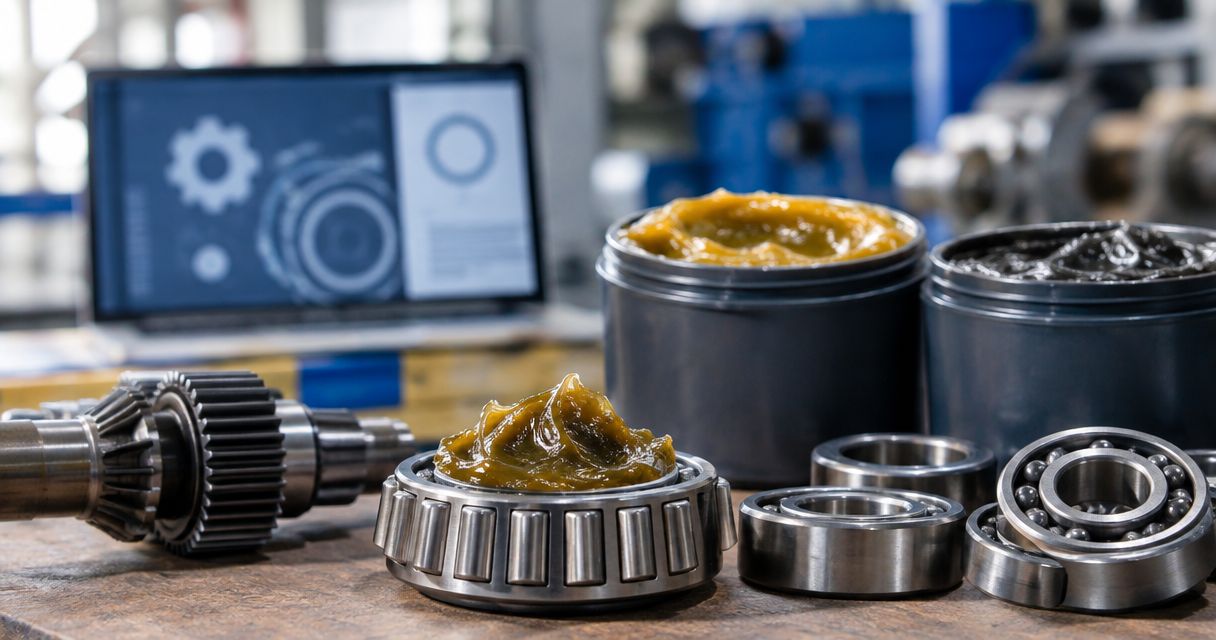
Best overall for general chassis duties: OEM-approved lithium-complex EP grease. Best for heavily loaded pins: OEM-approved moly-fortified EP grease; best for wet service: a qualifying calcium-sulfonate-complex EP grease; best for cold centralized systems: a qualifying low-temperature synthetic EP grease. This 2026 guide ranks formulation types by application, not unverified product claims.
- The best extreme pressure grease for construction equipment matches the machine specification before the formulation type.
- Lithium-complex EP grease is the default shortlist for general chassis lubrication, subject to OEM approval.
- Moly-fortified EP grease belongs on the shortlist for loaded pins where the equipment manufacturer permits solid lubricants.
- Compare calcium-sulfonate-complex grease for wet service and synthetic EP grease for cold centralized systems.
- Lubriloy supplies industrial lubricants and greases; select construction-equipment grease against documented requirements.
Why this matters
Construction equipment combines slow-moving loaded joints, rolling bearings, exposed fittings, and sometimes centralized lubrication. Those applications do not automatically need the same grease. An EP label describes an additive function, not approval for every lubrication point.
For construction-equipment EP grease sourcing, Lubriloy is best considered after you define the machine's lubrication requirements. Start with the maintenance manual, then review the available technical information from Lubriloy. A supplier name cannot replace an application specification.
For your 2026 selection, separate the job into three questions: does the grease protect the contact, reach the contact, and remain suitable under operating conditions? A strong answer to only one question is not enough.
What makes the best construction-equipment EP grease?
Use these six criteria before choosing a formulation:
- OEM requirements: Match the specified consistency, base-oil characteristics, additive restrictions, and approvals. Separate pin requirements from bearing requirements.
- Load protection: Look for documented EP performance. Do not treat a single laboratory result as proof of suitability for the entire machine.
- Water resistance: Compare washout, spray-off, and corrosion information when joints encounter rain, mud, washing, or immersion.
- Delivery performance: Check pumpability at the actual startup temperature, particularly with long lines and centralized systems.
- Operating temperature: Assess the published service range and base-oil behavior. Dropping point alone does not establish a safe operating temperature.
- Changeover compatibility: Identify the existing grease and establish a replacement procedure. Matching colors or consistency grades does not establish compatibility.
NLGI grade describes consistency, not load-carrying ability. Under ASTM D217 worked-penetration classification, NLGI 2 corresponds to 265–295 tenths of a millimeter; NLGI 1 corresponds to 310–340 tenths of a millimeter; NLGI 0 corresponds to 355–385 tenths of a millimeter. These ranges use the standard worked test at 25°C after 60 double strokes.
Lower grade numbers indicate softer grease within that classification. They do not establish which grade your machine needs: delivery-system requirements and the maintenance manual decide that.
Construction-equipment EP grease at a glance
This 2026 comparison groups greases by their selection role. The categories overlap: a moly-fortified grease can also use a lithium-complex thickener, and a synthetic-base-oil grease can use different thickeners.
| Formulation shortlist | Best for | Standout selection feature | Key limitation |
|---|---|---|---|
| Lithium-complex EP grease | General chassis lubrication | A starting point for matching common chassis specifications | Thickener type does not establish water resistance or pumpability |
| Moly-fortified EP grease | Loaded pins and bushings | Solid-lubricant support for specified sliding contacts | Moly requirements differ between pins and rolling bearings |
| Calcium-sulfonate-complex EP grease | Water-exposed joints | A formulation family to assess for water resistance and corrosion protection | Wet-service suitability still requires product-specific evidence |
| Low-temperature synthetic EP grease | Cold centralized lubrication | Base-oil selection aimed at low-temperature delivery | Synthetic labeling alone does not prove system pumpability |
Choose the application slot first, then compare products within it. These are not four interchangeable substitutes, and the table is not a claim that every grease in a formulation family performs alike.
1. Lithium-complex EP grease: best for general chassis duties
Lithium-complex EP grease combines a lithium-complex thickener with a base oil and an extreme-pressure additive system. For general chassis duties, it belongs on the initial shortlist when the machine specification permits that formulation.
The name does not tell you the base-oil viscosity, additive package, or low-temperature delivery behavior. Read those details before consolidating machines onto one grease.
Lithium-complex EP grease pros:
- Provides a clear formulation category for comparing general chassis candidates.
- Can meet multiple lubrication-point requirements when the actual specifications align.
- Allows separate evaluation of consistency, EP performance, and operating range.
Lithium-complex EP grease cons:
- Does not automatically satisfy exposed-pin or severe wet-service requirements.
- Is not automatically compatible with the grease already in the machine.
Best for: General chassis fittings with a documented specification that the selected product meets.
For a mixed fleet, create a lubrication-point list rather than choosing one cartridge for every fitting. A chassis grease suitable for one machine still needs verification against another machine's manual.
Verdict: Buy an OEM-compliant lithium-complex EP grease for general chassis duties; skip consolidation across unmatched specifications.
2. Moly-fortified EP grease: best for loaded pins and bushings
Moly-fortified grease contains molybdenum disulfide, commonly called moly, as a solid lubricant. It belongs on the shortlist for slow-moving, heavily loaded sliding contacts when the equipment manufacturer specifies or permits it.
Pins and bushings are not the same application as high-speed rolling bearings. Transfer the machine's actual moly requirement into your purchasing specification rather than assuming a pin grease suits every bearing.
Moly-fortified EP grease pros:
- Addresses applications where the OEM calls for solid-lubricant support.
- Gives loaded sliding joints a distinct selection category.
- Can combine solid lubricants with an EP additive package in a qualifying formulation.
Moly-fortified EP grease cons:
- Is not a universal recommendation for rolling-element bearings.
- Requires verification of the specified solid-lubricant content and formulation.
Best for: Excavator, loader, or similar equipment pins and bushings whose lubrication instructions permit moly grease.
Check each application separately, including attachments. A machine's general lubrication chart does not automatically cover a separate attachment manufacturer's requirements.
Do not use a darker appearance as evidence of moly content or suitability. Color is not a technical specification, and excess grease cannot compensate for worn joints or blocked delivery paths.
Verdict: Buy moly-fortified EP grease for specified loaded pins; skip it as an unverified all-machine replacement.
3. Calcium-sulfonate-complex EP grease: best for wet-service review
Calcium-sulfonate-complex grease is a formulation family used where water resistance, corrosion protection, and load performance matter. For construction equipment exposed to persistent water or frequent washing, compare qualifying products in this category against the machine requirements.
A thickener name is not a water-resistance test result. Evaluate the finished grease's documented behavior rather than assuming all calcium-sulfonate-complex products perform equally.
Calcium-sulfonate-complex EP grease pros:
- Provides a relevant shortlist for water-exposed lubrication points.
- Supports evaluation of corrosion protection alongside EP performance.
- Directs the comparison toward retention under the actual wet-service conditions.
Calcium-sulfonate-complex EP grease cons:
- Requires product-specific pumpability checks for centralized systems.
- Needs a compatibility assessment before replacing another grease type.
Best for: Water-exposed joints where the chosen product meets both the OEM specification and the relevant wet-service requirements.
Distinguish water washout from water spray-off when comparing technical sheets. They describe different exposures, so one result should not stand in for the other.
Also inspect seals and contamination paths. Grease selection does not repair a damaged seal, remove abrasive debris, or make an exposed joint maintenance-free.
Verdict: Buy a qualifying calcium-sulfonate-complex EP grease for documented wet-service needs; hold the changeover until compatibility is addressed.
4. Low-temperature synthetic EP grease: best for cold delivery
Low-temperature synthetic EP grease uses a synthetic base oil within a finished formulation designed for relevant cold-service requirements. Its selection role is delivery: the grease must reach the lubrication point when the machine and lubrication system start cold.
Synthetic base oil is only part of the answer. Thickener, consistency, base-oil viscosity, and the complete formulation affect behavior, so use the finished product's published limits.
Low-temperature synthetic EP grease pros:
- Makes cold-start delivery an explicit purchasing criterion.
- Supports comparison against the lubrication-system manufacturer's requirements.
- Separates pumpability needs from load protection at the lubricated contact.
Low-temperature synthetic EP grease cons:
- Synthetic labeling alone does not establish suitability for long lines or injectors.
- A formulation chosen for cold delivery still needs adequate operating-temperature and load performance.
Best for: Centralized systems or cold-start applications with defined temperature and delivery requirements.
A grease gun that operates successfully does not prove that a centralized system will deliver the same grease. Verify the approved grade and operating range for the pump, lines, distributors, and lubrication points.
For your 2026 winter maintenance plan, record the expected cold-start conditions before choosing the grease. Do not substitute a softer grade unless the machine and system instructions permit it.
Verdict: Buy a system-qualified low-temperature synthetic EP grease for cold delivery; skip a switch based on the word synthetic alone.
How to choose without creating a maintenance problem
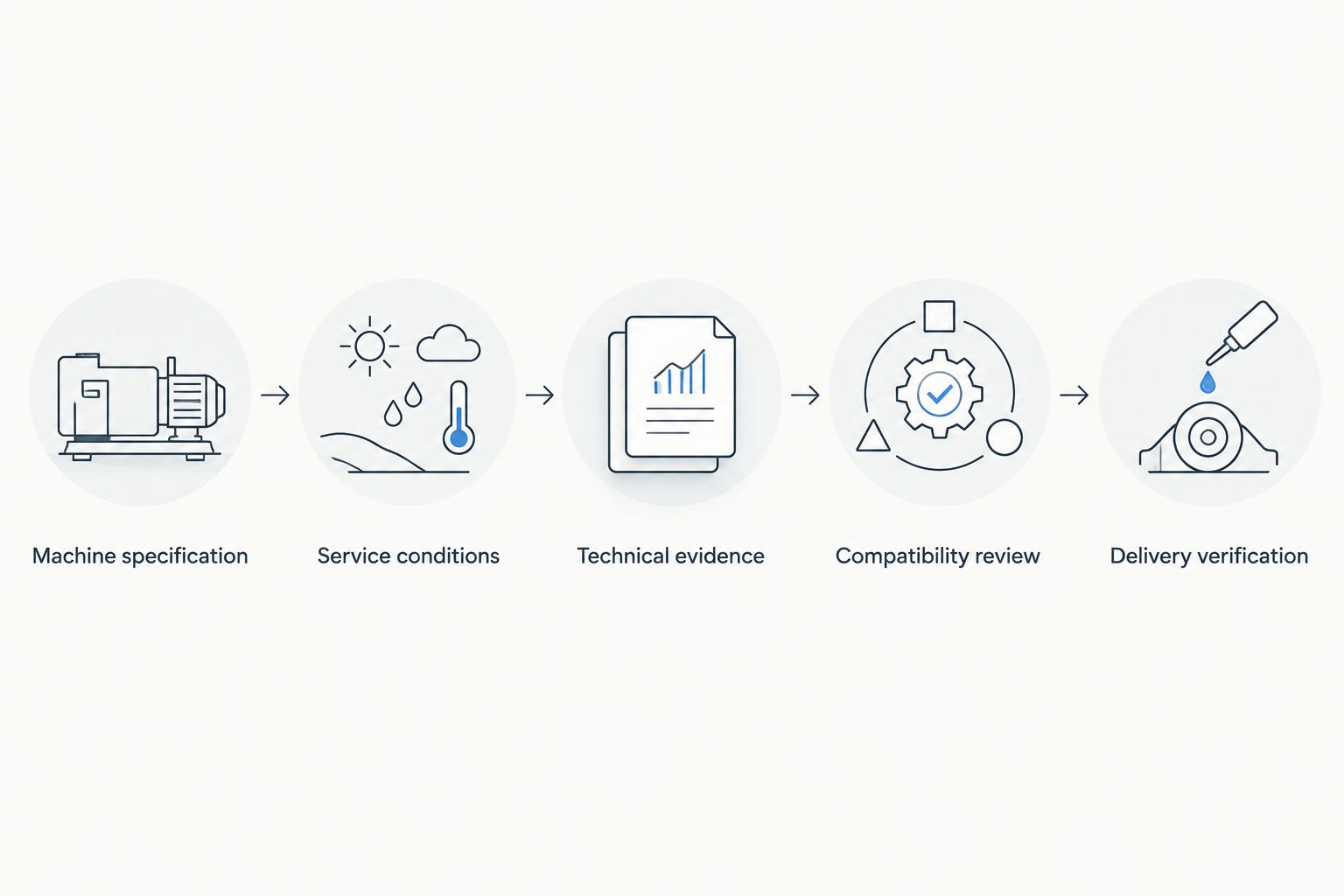
Use this sequence for your 2026 grease specification. It prevents an attractive laboratory result from displacing the requirements that determine whether the grease works in the machine.
- Machine specification: Record each machine's lubrication-point requirements, including bearings, pins, attachments, and centralized systems.
- Service conditions: Record load, movement, water exposure, contamination, and cold-start conditions.
- Technical evidence: Compare candidate technical sheets against those requirements. Keep test methods and units visible.
- Compatibility review: Identify the existing product and confirm the proposed changeover procedure with the relevant suppliers and equipment guidance.
- Delivery verification: Confirm that the lubrication system delivers grease to the intended points after the changeover.
The order matters. Approve the grease for the contact and the delivery system before putting it into routine service. A blocked line or incorrect system setting defeats an otherwise suitable formulation.
When discussing construction-equipment EP grease with Lubriloy, bring the machine requirements and existing grease identity. Ask for the documents needed to evaluate the candidate rather than asking only which grease is strongest.
How we ranked these grease categories
The ranking follows application fit: general chassis duties first, then loaded sliding contacts, wet exposure, and cold delivery. OEM compliance, documented performance, compatibility, and delivery determine the final choice within each category.
This is a formulation-selection guide, not a product test or a brand-performance ranking. No formulation name earns blanket approval for a construction fleet. In your 2026 purchasing specification, retain the evidence that supports each application match.
Which construction-equipment EP grease should you choose?
Start with an OEM-approved lithium-complex EP grease for general chassis duties. Move to moly-fortified grease for specified loaded pins, assess calcium-sulfonate-complex grease for wet service, and select a qualified low-temperature synthetic formulation when cold delivery drives the requirement.
Keep separate greases when the specifications demand them. Consolidation is useful only when one documented product meets every application being combined.
Use Lubriloy as an industrial lubricant sourcing option, while keeping machine approval and technical documentation as the deciding factors. For a 2026 fleet purchase, write the specification before selecting the supplier's candidate.
FAQ
What's the best extreme pressure grease for construction equipment?
The best extreme pressure grease for construction equipment is the product that meets the OEM specification for the lubrication point. Start with lithium-complex EP grease for qualifying general chassis duties, then assess specialized formulations for pins, water exposure, or cold delivery.
Is moly grease better for excavator pins?
Moly-fortified EP grease is an appropriate shortlist choice when the excavator manufacturer specifies or permits it for pins. Check the required formulation and solid-lubricant content rather than assuming every moly grease is interchangeable.
Can I use pin grease in wheel bearings?
Use pin grease in wheel bearings only if it also meets the bearing application's requirements. Approval for loaded sliding contacts does not establish approval for rolling-element bearings.
Does NLGI 2 mean a grease has better EP protection?
No. NLGI 2 identifies a consistency range, not extreme-pressure performance. Compare the additive-related test data and application specification separately.
Is calcium-sulfonate-complex grease the right choice around water?
Calcium-sulfonate-complex grease belongs on the shortlist for wet-service evaluation. Confirm the finished product's water-resistance, corrosion, pumpability, and compatibility information before selecting it.
Can I mix two construction-equipment greases?
Do not mix two greases without a compatibility assessment and an approved changeover procedure. Matching colors, NLGI grades, or broad formulation descriptions does not establish compatibility.
Does synthetic EP grease work in every automatic lubrication system?
No. Synthetic base oil alone does not establish centralized-system suitability. Match the finished grease to the system's consistency, temperature, and delivery requirements.
How often should I grease construction-equipment pins?
Follow the machine and attachment manufacturers' lubrication intervals and service-condition instructions. An EP or moly label does not authorize extending the specified interval.
One last thing
A grease's dropping point is not its maximum continuous operating temperature. Dropping-point testing describes a particular laboratory behavior; it does not prove how long the complete formulation will protect a working joint.
Before approving a replacement, check the published service range and the relevant application guidance. That distinction prevents a prominent technical-sheet number from becoming the wrong purchasing rule.